
Perimenopause is defined by hormonal fluctuation—but not in a steady, predictable way. Estrogen and progesterone don’t simply decline. They surge, dip, and shift unpredictably from one cycle to the next.
This volatility is what makes the experience feel so destabilizing.
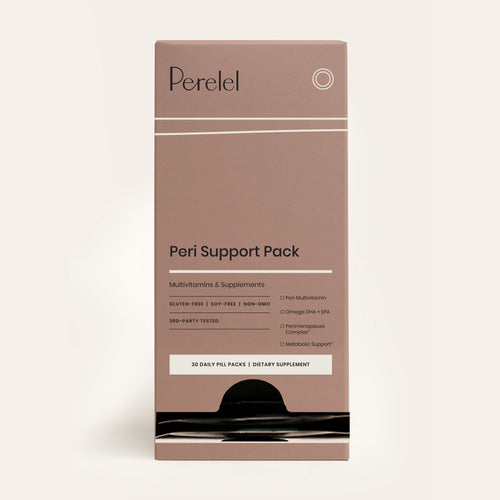
Perimenopause Support Pack
$58.95
/ Month
Shop the Article:

Shop Now
It Doesn’t Start With Hot Flashes
We’ve been taught to associate menopause with hot flashes and missed periods—but perimenopause rarely announces itself that clearly.
Instead, it shows up in subtle shifts:
-
Your sleep gets lighter or more interrupted
-
Your mood feels less steady
-
Your energy fluctuates in ways you can’t predict
-
Your stress tolerance shrinks
These are some of the most common early signs of hormonal imbalance—changes in energy, sleep, mood, and even weight that feel hard to pin down.
And this stress shift has been documented: women in early and late perimenopause perceive significantly higher stress than premenopausal women, with one study up to 80% of perimenopausal women experience moderate stress in perimenopause.
Why Stress Suddenly Feels So Much Harder
One of the most overlooked shifts in perimenopause is how your body handles stress.
Estrogen plays a role in regulating cortisol—your primary stress hormone. When estrogen fluctuates, your stress response becomes less predictable. Harder to turn off, and easier to trigger.
At the same time:
-
Progesterone (your body’s natural calming hormone) declines
-
Sleep becomes more fragmented
-
The brain becomes more sensitive to emotional stimuli
This is why so many women describe feeling like they’re “not themselves.”
And it’s not in your head—it’s physiological.
Stress Doesn’t Work in a Silo
Research suggests that the hormonal shifts of perimenopause don’t just drive symptoms directly—they also reshape the body’s stress response. Fluctuating estrogen can alter HPA axis signaling and cortisol rhythms, which have been linked to more severe hot flashes, disrupted sleep, and increased mood symptoms. Even still, sleep disruption (night sweats, anxiety) increases next-day cortisol even when perceived stress is low. And the stress hormone, cortisol, rises during late-stage menopausal transition and is significantly associated with estrone, testosterone, and FSH levels.
Think about it this way: as you move through this hormonal transition, your ability to handle stress may start to feel different—often more heightened or harder to regulate.
This shift can recalibrate how the nervous system responds to everyday stressors, helping explain why this stage of life is often linked with increased vulnerability to anxiety, low mood, and sleep disruption. While progesterone is commonly thought of as a reproductive hormone, it also has important effects on the brain—supporting a sense of calm, resilience, and neurological balance.
In this way, stress becomes less of a side effect and actually something that influences how intensely symptoms are felt across the board.
The Clinical Trial: Inside the Perimenopause Support Pack—and Why It Matters
To better understand how targeted nutritional support could impact this experience, we at Perelel set out to conduct comprehensive, rigorous, third-party research to support our evidence-based ingredients: a double-blind, randomized, placebo-controlled trial—the gold standard in clinical research.
Researchers studied 389 perimenopausal women over six weeks—looking specifically at perceived stress and menopausal symptoms.
73% of women experienced clinically meaningful improvements in stress.
This was clinically meaningful, statistically significant, and the shift was large enough to actually change how they functioned day to day.
What Support Actually Looks Like
This is where something like the Perimenopause Support Pack comes in—as a structured, daily routine to support what’s actually changing in your body.
Instead of isolating one symptom, it’s designed as a multi-formula routine that addresses the full picture:
-
A foundational multivitamin for baseline nutritional support for this stage (with extra B12 and vitamin D)
-
Omega-3s for brain, mood, and cardiovascular health
-
Metabolic support (like berberine and L-carnitine) to stabilize energy and blood sugar
-
A targeted perimenopause complex with ingredients like DIM (for estrogen metabolism) and rhubarb extract
-
Ashwagandha, providing clinically proven stress and emotional support
-
Polyphenols and antioxidants to support with healthy inflammatory response
Because your body isn’t the same as it was five years ago—and your support shouldn’t be either.
Sources
-
Thurston RC, Joffe H. Vasomotor symptoms and menopause: findings from the Study of Women’s Health Across the Nation (SWAN). Obstet Gynecol Clin North Am. 2011.
-
Freeman EW et al. Associations of hormones and menopausal status with depressed mood in women with no history of depression. Arch Gen Psychiatry. 2006.
-
Gordon JL et al. Estradiol variability, stress, and mood in the menopause transition. Menopause. 2015.
-
Woods NF, Mitchell ES. Symptom interference with work and relationships during the menopausal transition and early postmenopause. Menopause. 2011.
-
Raison CL, Miller AH. The neuroimmunology of stress and depression. Semin Clin Neuropsychiatry. 2003.
-
Toufexis D et al. Estrogen and the stress response: interactions with the HPA axis. Endocrinology. 2014.
-
Melby MK et al. Vasomotor symptoms and menopause: a review of physiological mechanisms. Reprod Sci. 2012.
This article is for informational purposes only. It is not, nor is it intended to be, a substitute for professional medical advice, diagnosis, or treatment and we recommend that you always consult with your healthcare provider. To the extent that this article features the advice of physicians or medical practitioners, the views expressed are the views of the cited expert and do not necessarily represent the views of Perelel.